
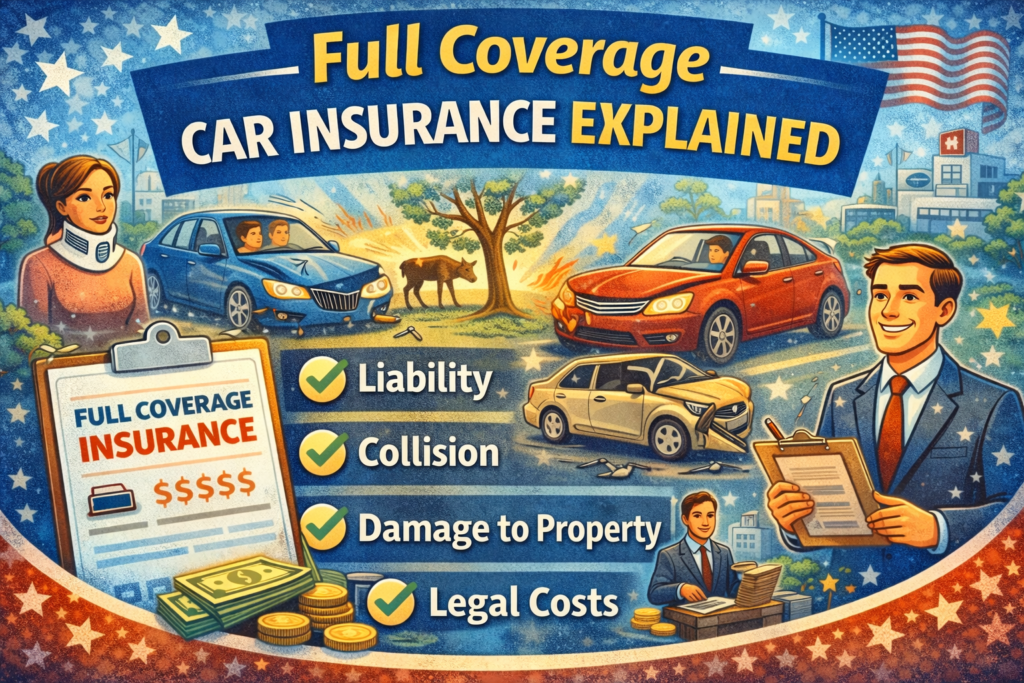
Full Coverage Car Insurance Explained (Complete Guide for U.S. Drivers)
If you’ve ever shopped for car insurance in the United States, you’ve probably heard the phrase “full coverage car insurance.” Insurance agents throw the term around all the time, and many drivers assume it means their car is protected from absolutely everything.
But here’s the deal: full coverage car insurance isn’t actually a specific policy type.
Instead, it’s a combination of several coverages that provide broader financial protection for drivers. For many Americans, full coverage insurance offers peace of mind because it protects both you and your vehicle in a wide range of situations.
In this guide, we’ll break down what full coverage car insurance really means, what it covers, how much it costs, and whether you actually need it.
Let’s get started.
What Is Full Coverage Car Insurance?
Full coverage car insurance usually refers to a policy that includes three major types of coverage:
- Liability Insurance
- Collision Insurance
- Comprehensive Insurance
Together, these coverages protect you financially if you:
- Cause an accident
- Damage your own vehicle
- Experience theft or natural disasters
Many drivers search online for terms like:
- what does full coverage car insurance include in the USA
- cheap full coverage car insurance for new drivers
- how full coverage auto insurance works
Understanding this coverage can help you make a smarter decision when choosing an insurance policy.
What Does Full Coverage Car Insurance Include?
Let’s break down each type of coverage included in full coverage insurance.
1. Liability Coverage
Liability insurance is required by law in most U.S. states. It protects you if you cause injuries or property damage to others.
Liability Coverage Pays For
- Medical bills for other drivers
- Injuries to passengers
- Property damage (cars, fences, buildings)
- Legal fees if you’re sued
For example:
If you accidentally rear-end another car and cause $25,000 in damages, your liability coverage helps pay those costs.
However, liability insurance does not cover your own vehicle.
2. Collision Coverage
Collision coverage pays for damage to your car after an accident, regardless of who caused it.
This includes accidents such as:
- Hitting another vehicle
- Crashing into a guardrail
- Rolling your car
- Hitting a pothole
- Colliding with a tree
Example
Let’s say you accidentally slide on an icy road and hit a street sign.
The repair bill for your car is $5,000.
Your collision insurance would help pay for those repairs (minus your deductible).
3. Comprehensive Coverage
Comprehensive insurance protects your car from non-collision events.
These are incidents that happen outside of regular accidents.
Comprehensive Coverage Protects Against
- Car theft
- Vandalism
- Fire damage
- Floods
- Hailstorms
- Falling trees
- Animal collisions (like hitting a deer)
Example
If a tree falls on your parked car during a storm, comprehensive insurance would cover the damage.
Why Many Drivers Choose Full Coverage Insurance
Many Americans prefer full coverage because it offers much broader financial protection than basic liability insurance.
Key Benefits
Protection for Your Own Vehicle
Full coverage helps pay for repairs or replacement of your car.
Protection From Natural Disasters
Storm damage, floods, and fires can be expensive without coverage.
Peace of Mind
Drivers feel safer knowing they’re protected from unexpected accidents.
Lender Requirements
If you financed your car, your lender will usually require full coverage.
What Full Coverage Car Insurance Does NOT Cover
Even though it’s called “full coverage,” it doesn’t actually cover everything.
Here are some things typically not covered.
Exclusions
- Regular vehicle maintenance
- Mechanical breakdowns
- Wear and tear
- Driving for rideshare without proper coverage
- Intentional damage
- Driving under the influence
To cover mechanical issues, drivers sometimes purchase extended warranties or mechanical breakdown insurance.
How Much Does Full Coverage Car Insurance Cost?
Full coverage insurance costs more than liability-only insurance because it protects your vehicle as well.
Average monthly cost in the United States:
- $120 to $250 per month
But your premium depends on several factors.
Factors That Affect Full Coverage Insurance Rates
Insurance companies evaluate many details before calculating your premium.
Major Factors
- Age
- Driving record
- Credit score
- Location
- Type of car
- Annual mileage
- Claim history
Example
A driver with a clean record might pay $140/month, while a high-risk driver could pay $300/month or more.
Understanding Deductibles
Both collision and comprehensive coverage come with deductibles.
A deductible is the amount you must pay before insurance covers the rest.
Example
Your deductible: $500
Repair cost: $3,000
You pay: $500
Insurance pays: $2,500
Higher deductibles usually result in lower monthly premiums.
Who Should Get Full Coverage Car Insurance?
Full coverage is ideal for drivers who want strong financial protection.
Full Coverage Is Recommended For
- New vehicles
- Financed or leased cars
- Expensive vehicles
- Drivers in high-traffic areas
- Drivers who cannot afford large repair bills
When Liability Insurance May Be Enough
In some cases, full coverage may not make sense financially.
Liability Only May Work If
- Your car is very old
- Your car is worth less than $3,000
- You rarely drive
- You can afford to replace your car
Many experts recommend dropping full coverage once the vehicle value becomes very low.
Real-Life Example of Full Coverage Insurance
Let’s say David owns a 2023 sedan and has full coverage insurance.
One night, a severe storm hits his area and a large tree branch crashes onto his car.
Damage repair cost: $7,000
David’s comprehensive deductible: $500
His insurance pays:
$6,500
Without comprehensive coverage, David would have to pay the entire $7,000 repair bill himself.
Tips to Find Cheap Full Coverage Car Insurance
Full coverage doesn’t have to break the bank.
Here are some smart ways to lower your premium.
Compare Multiple Insurance Companies
Shopping around can help you find the best deal.
Bundle Policies
Combining auto and home insurance often results in discounts.
Maintain Good Credit
In many states, credit score affects insurance pricing.
Drive Safely
Avoiding accidents keeps premiums low.
Increase Your Deductible
Higher deductibles reduce monthly costs.
Long-Tail Keywords Related to Full Coverage Insurance
If you’re researching this topic online, you may come across searches like:
- best full coverage car insurance for young drivers
- cheap full coverage car insurance in the USA
- what does full coverage auto insurance include
- full coverage vs liability insurance explained
- average cost of full coverage car insurance in America
These long-tail keywords help drivers find detailed answers to their insurance questions.
FAQs About Full Coverage Car Insurance
What does full coverage car insurance actually cover?
Full coverage typically includes liability, collision, and comprehensive insurance, protecting both you and your vehicle.
Is full coverage required by law?
No. Only liability insurance is legally required in most states.
However, lenders may require full coverage if you financed your car.
How much is full coverage insurance per month?
The average cost ranges between $120 and $250 per month, depending on the driver and vehicle.
When should I drop full coverage insurance?
Many drivers drop full coverage when their car’s value drops below $3,000 to $4,000.
Is full coverage worth it?
For newer or valuable vehicles, full coverage can provide important financial protection and peace of mind.
Final Thoughts
Full coverage car insurance provides broad protection for both you and your vehicle.
It typically combines three essential coverages:
- Liability insurance
- Collision insurance
- Comprehensive insurance
While it costs more than basic liability coverage, it protects drivers from expensive repair bills, theft, and unexpected accidents.
For many Americans—especially those with newer vehicles—full coverage insurance offers valuable peace of mind.
Before choosing a policy, it’s always smart to compare quotes, evaluate your car’s value, and choose coverage that fits your budget and risk level.