
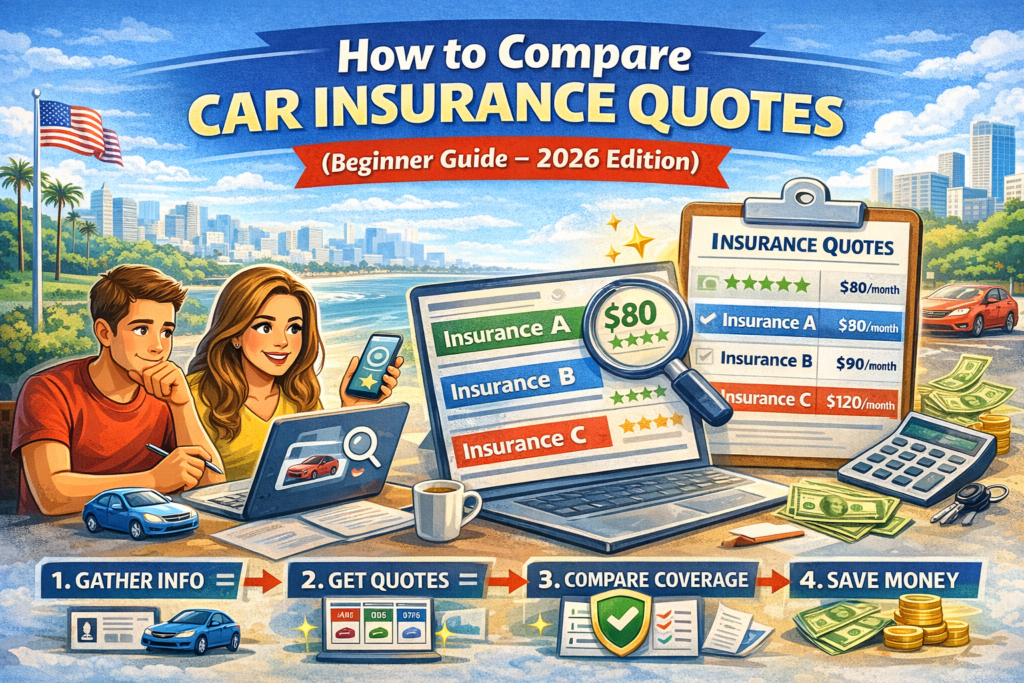
Learn how to compare car insurance quotes in the US (2026 beginner guide). Save money, avoid mistakes, and choose the best policy with this simple step-by-step guide.
Let’s be real for a second…
You open your email, see a car insurance quote, and think:
“Wait… why is this so expensive?”
Then you check another company—and boom—it’s completely different.
Now you’re confused.
Which one is actually better?
Which one is cheaper long-term?
And are you about to make a costly mistake?
If you’ve ever felt stuck comparing car insurance quotes in the U.S., you’re not alone.
“Most people don’t overpay because insurance is expensive—they overpay because they don’t know how to compare quotes properly.”
This 2026 beginner-friendly guide will change that.
The Problem
Most drivers compare insurance quotes the wrong way.
They:
- Only look at price
- Ignore coverage details
- Miss hidden costs
Result? Cheap policy… expensive mistake.
The Agitation
Imagine choosing the cheapest quote…
Then getting into an accident—and realizing:
- Your coverage is too low
- Your deductible is too high
- Your claim isn’t fully covered
Now that “cheap” policy costs you thousands.
The Solution
Let’s simplify everything.
In this guide, you’ll learn:
- How to compare quotes step-by-step
- What actually matters (not just price)
- How to save money smartly
- Mistakes to avoid
What Is a Car Insurance Quote? (Simple Explanation)
A car insurance quote is:
An estimate of how much you’ll pay for coverage based on your profile.
It depends on:
- Age
- Driving history
- Location
- Car type
- Coverage level
Why Quotes Are Different (Important Insight)
| Factor | Impact on Price |
| Driving record | High |
| Credit score | Medium |
| Location | High |
| Vehicle type | Medium |
Step-by-Step: How to Compare Car Insurance Quotes
Step 1: Gather Your Information
Before comparing, collect:
- Driver’s license
- Vehicle details
- Driving history
Step 2: Get Multiple Quotes
Aim for at least 3–5 companies
Step 3: Compare Coverage (NOT Just Price)
Example Table:
| Company | Premium | Deductible | Coverage |
| Company A | $100 | $500 | Full |
| Company B | $80 | $1,000 | Limited |
| Company C | $120 | $250 | Premium |
Cheapest isn’t always best.
Step 4: Check Deductibles
Higher deductible = lower premium (but higher risk)
Step 5: Review Coverage Types
Must Check:
- Liability
- Collision
- Comprehensive
- Uninsured motorist
Step 6: Look for Discounts
Common Discounts:
- Safe driver
- Multi-policy
- Good student
- Low mileage
Step 7: Check Company Reputation
Look at:
- Customer reviews
- Claim settlement speed
- Financial strength
Cheap vs Best Value (Comparison)
| Feature | Cheap Policy | Best Value Policy |
| Monthly cost | Low | Medium |
| Coverage | Basic | Strong |
| Risk | High | Low |
Real-Life Example
Case: Ryan from Texas
Ryan chose the cheapest quote at $70/month.
After accident:
Paid $2,500 out of pocket
Next time, he compared properly.
- Paid $95/month
- Saved thousands later
Pro Tips to Compare Like a Pro
Do This:
- Compare same coverage levels
- Check deductibles carefully
- Ask questions
Avoid This:
- Comparing different coverage
- Ignoring fine print
- Choosing based on price only
Common Mistakes to Avoid
- Not reading policy details
- Skipping uninsured coverage
- Ignoring customer service ratings
Internal Links
https://insurancesimplifiedusa.com
Best Coverage for Beginners
| Coverage Type | Recommended |
| Liability | High |
| Collision | Yes |
| Comprehensive | Yes |
| Uninsured Motorist | Yes |
How Much Can You Save?
Average Savings:
- $300–$1,000/year
Tools to Compare Quotes
Options:
- Insurance websites
- Comparison tools
- Insurance agents
Key Takeaways
- Always compare multiple quotes
- Focus on coverage—not just price
- Check deductibles and limits
- Read the fine print
FAQs (Very Important)
1. How many quotes should I compare?
At least 3–5.
2. What is the most important factor?
Coverage, not price.
3. Can I compare quotes online?
Yes, easily.
4. Why are quotes so different?
Different risk calculations.
5. Should I choose cheapest option?
Not always.
6. How often should I compare?
Every 6–12 months.
7. Does comparing affect credit score?
No (soft checks only).
8. What coverage is best?
Depends on your needs.
9. Can I switch after comparing?
Yes, anytime.
10. How long does it take?
15–30 minutes.
External Sources
- National Association of Insurance Commissioners
- Insurance Information Institute
- USA.gov
Conclusion
Comparing car insurance quotes doesn’t have to be confusing.
“The goal isn’t to find the cheapest policy—it’s to find the smartest one.”
Take your time. Compare properly. Ask questions.
And most importantly—protect yourself the right way.
Want more beginner-friendly guides?
https://insurancesimplifiedusa.com/
People also ask
What is the best way to compare car insurance?
- Check coverage limits, deductibles and features.
- Research the Insurance provider companies.
- Consider the whole package.
- Check Coverage amounts.
- Check rates for 20-, 40- and 60-year-old drivers.
- Check rates for drivers after an accident, DUI or speeding ticket.
- Check rates for drivers with poor credit.
How to get the best quote for car insurance?
- Decide about the coverages you need.
- Decide on optional coverages.
- Research the financial condition of several insurance providers.
- Shop around! Get several quotes and compare car insurance.
- Confirm you’re getting the best price.
How to compare best car insurance?
- One of the best tip that you can get is to compare car insurance plans online.
- Check the claim settlement ratio.
- Look at the premium rates.
- Check the location of network garages.
- Check for customer reviews and feedback (Most Important).
What does $100 k /$ 300k /$ 100k mean?
The numbers in the coverage refer to the maximum amount your insurer will pay out for each type of claim. So, in a 100/300/100 policy, you would have $100,000 coverage per person, $300,000 in body injury coverage per accident, and $100,000 in property damage coverage per accident.
What are the 4 types of insurance?
Most experts agree that life, health, long-term disability, and auto insurance are the four types of insurance you must have. Employer coverage is often the best option, but if that is unavailable, obtain quotes from several providers.
Is GEICO or Progressive better?
Geico is the better company for most drivers because of its generally low rates and higher potential savings with discounts. Geico also scores slightly better with customers than Progressive does, based on their ratings from J.D. Power and the National Association of Insurance Commissioners (NAIC).
Is it better to have a $500 deductible or $1000?
If you choose a $500 deductible, your rate will be higher than if you choose a $1,000 deductible. If you were to file a claim with a $500 deductible, however, your out-of-pocket cost would be $500 less than if you filed a claim with a $1,000 deductible.
Which comparison site is most reliable?
Google Shopping is one of the largest price comparison shopping engines available. Yahoo Shopping is another great price comparison website. Pronto is a useful tool for retailers. PriceGrabbe helps you compare prices across a variety of products from different brands.
What not to tell your insurance company?
Any Information about Your Medical History without guidance. Insurance companies often ask about pre-existing conditions so they can argue your injuries weren’t caused by the crash. Without legal advice, you might reveal more than necessary, and that can go wrong.
What are the top 5 best car insurance companies?
| Brand | U.S. News Rating | State Availability |
| GEICO | 4.8 U.S. News Rating | 50 States and DC |
| USAA | 4.7 U.S. News Rating | 50 States and DC |
| PROGRESSIVE | 4.6 U.S. News Rating | 50 States and DC |
| NATIONWIDE | 4.3 U.S. News Rating | 46 States and DC |
Which is better, 3rd party or comprehensive?
Third-party insurance does not cover any damages caused to your vehicle or you. For that, you need to get a comprehensive car insurance policy to stay fully covered. A comprehensive car insurance policy covers damages caused to your insured vehicle as well as to a third party.
What is the cheapest type of insurance?
Third party cover is the minimum level required by law and normally the cheapest cover available. It only covers you for damaging someone else’s car (or property) or injuring another person (a ‘third party’) in an accident. It won’t cover any injuries to you or damage to your car.
How much is a $300,000 insurance policy?
The national average cost of home insurance is $2,424 per year for a policy with a $300,000 dwelling limit. This comes out to about $202 per month.
What does a 50/50 mean in an auto insurance claim?
In 50/50 insurance claims, each party owes the other 50% of their total material damages. This doesn’t mean that each party owes the other the same amount of money. If you’re driving a Mercedes, and an old Yugo hits you, your property damage is going to be a lot more than the other driver’s.
What does it mean if the coverage limits are $50,000 / $100,000?
If you carry auto insurance with liability coverage limits of $50,000/$100,000/$30,000, those numbers are broken down as follows: $50,000: The maximum amount your insurer will pay for bodily injuries per person. $100,000: The total amount your insurer will pay for bodily injuries per accident.
What are the 4 P’s of insurance?
The document outlines the 4 P’s of life insurance marketing:
- Product
- Price
- Placement
- Promotion
It emphasizes the importance of understanding different policy types, factors affecting premiums, choosing the right distribution channels, and implementing effective marketing strategies.
SEO Keywords
Primary Keywords:
- how to compare car insurance quotes in the US
- compare insurance quotes beginner guide
- car insurance comparison 2026
Long-Tail Keywords:
- best way to compare car insurance quotes USA
- how to find cheapest car insurance USA
- compare insurance quotes explained simply